Why Professional Tree Pruning Matters
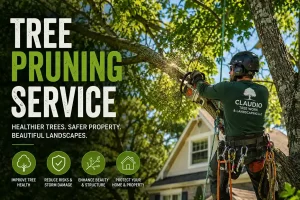
A professional Tree Pruning Service does much more than shorten branches or improve the appearance of a yard. Proper pruning supports tree health, reduces structural hazards, improves clearance, and helps trees grow safely around homes, driveways, sidewalks, utility lines, and other landscape features.
Trees constantly respond to sunlight, wind, rainfall, soil conditions, insects, disease, and competition from nearby vegetation. Over time, branches may become dead, crowded, damaged, overextended, or poorly attached.
Selective pruning addresses these problems without removing more living tissue than necessary. The goal is not to force every tree into a perfectly symmetrical shape. The goal is to create a safer, more balanced canopy that fits the tree species, age, condition, and location.
Across Connecticut communities such as New Milford, Danbury, Ridgefield, Sherman, Southbury, and Wilton, trees face heavy rain, strong wind, summer thunderstorms, winter snow, and seasonal temperature changes. These conditions can place stress on weak limbs and branch unions.
A tree may look healthy from the ground while carrying deadwood, cracked limbs, crossing branches, or excessive weight on one side of the canopy. Professional pruning helps identify and manage these concerns before they become larger problems.
What Is a Tree Pruning Service?
A tree pruning service is the planned removal or reduction of selected branches to improve a tree’s health, safety, structure, clearance, or appearance.
Proper pruning begins with an evaluation. Before making cuts, the tree service should consider the species, branch structure, visible defects, surrounding property, seasonal timing, and the homeowner’s goals.
Every pruning cut creates a wound that the tree must isolate and grow around. Trees do not heal like human skin. They compartmentalize damaged tissue and gradually form new wood around the cut.
This is why the size, location, and angle of each cut matter. Poor cuts can damage the branch collar, create decay pockets, encourage weak regrowth, or leave the tree vulnerable to insects and disease.
A professional assessment usually considers:
- Tree species and natural growth pattern
- Branch size, weight, and attachment
- Dead, broken, diseased, or crossing limbs
- Distance from roofs, roads, gutters, and utility lines
- The amount of live canopy that can be safely removed
- Storm exposure and surrounding targets
- The long-term effect of each pruning cut
The finished tree should still look natural. A healthy pruning job preserves foliage throughout the canopy instead of stripping the interior or cutting branches back to random stubs.
Tree Pruning vs. Tree Trimming
The terms tree pruning and tree trimming are often used interchangeably, but they can describe different priorities.
Tree pruning usually focuses on health, structure, and risk reduction. Tree trimming often focuses on shape, clearance, and routine maintenance.
In residential tree care, these services frequently overlap. A crew may remove dead limbs while also cutting branches away from a roof or driveway.
| Service | Main purpose | Common examples |
|---|---|---|
| Tree pruning | Tree health and structure | Removing deadwood, weak branches, and competing leaders |
| Tree trimming | Shape and clearance | Cutting branches away from roofs, roads, and windows |
| Structural pruning | Long-term stability | Developing strong scaffold branches and a dominant leader |
| Crown cleaning | Removing damaged growth | Dead, broken, diseased, or hanging limbs |
| Crown reduction | Managing canopy spread | Shortening selected branches to suitable lateral growth |
| Clearance pruning | Protecting property access | Creating space around buildings, walkways, and driveways |
The important difference is the purpose behind each cut. Cutting every branch that extends beyond an imaginary line may create a tidy shape, but it can also weaken the tree.
The Main Benefits of Tree Pruning
Professional pruning can benefit both the tree and the surrounding property.
Improving Tree Structure
Young and middle-aged trees may develop competing leaders, crowded branches, narrow unions, and weak attachments. These problems can become more serious as the branches grow heavier.
Structural pruning helps establish a stronger framework. It may include selecting a dominant leader, spacing primary branches, and reducing growth that competes with stronger parts of the canopy.
Correcting a small branch early usually creates less stress than removing a large limb years later. Early pruning can reduce future maintenance and help the tree develop a more stable shape.
Removing Dead and Broken Branches
Dead branches gradually lose strength. They can decay, split, or fall during wind, rain, snow, or even calm weather.
Broken limbs may remain partially attached after a storm. From the ground, they can appear stable while being supported by torn wood fibers or nearby branches.
Removing deadwood and storm-damaged limbs reduces hazards over:
- Driveways and parked vehicles
- Patios and outdoor seating areas
- Walkways and entrances
- Roofs, gutters, and siding
- Lawns and children’s play areas
The position of the branch matters as much as its condition. A dead limb over an unused wooded area does not create the same risk as one hanging above a front entrance.
Reducing Storm Damage Risks
Pruning cannot make a tree completely storm-proof. However, it can reduce specific defects that are more likely to fail during severe weather.
Long, overextended limbs act like levers. Dense branch clusters may catch more wind. Deadwood can break under wet snow, while weak branch unions may split when the canopy moves in different directions.
Selective reduction can shorten vulnerable branches while preserving enough foliage for photosynthesis and recovery.
This is especially important for properties in Stamford, Greenwich, Westport, Weston, Stratford, New Haven, and West Haven, where coastal winds and strong storms may affect exposed trees differently from inland trees.
Creating Clearance Around Homes
Branches that touch a roof can scrape shingles, clog gutters, trap moisture, and create access routes for squirrels and other wildlife.
Limbs near siding may rub against the exterior during windy conditions. Low branches can block driveways, sidewalks, traffic signs, or visibility near the road.
Clearance pruning creates space without unnecessarily removing an entire branch. In many cases, a limb can be shortened to a healthy lateral branch growing away from the structure.
This technique supports more natural future growth than cutting the branch at an arbitrary point.
Supporting Airflow and Sunlight
A crowded canopy may have poor airflow and uneven light distribution. Selective pruning can open specific areas and help foliage dry more efficiently after rain.
Additional sunlight may also benefit grass, shrubs, gardens, and lower parts of the canopy.
However, excessive thinning can cause problems. Removing too many interior branches may shift weight toward the ends of limbs, expose bark to sudden sunlight, and encourage weak water sprouts.
The objective is balance, not an empty canopy.
Common Signs That a Tree Needs Pruning
Some pruning needs are obvious. Others require a closer look at branch attachments, canopy density, and previous damage.
Dead or Leafless Branches
Dead limbs may remain leafless during the growing season, have loose bark, show fungal growth, or break easily.
Small dead twigs are common, but large dead branches over homes, vehicles, or frequently used spaces should be evaluated.
Broken or Hanging Limbs
Storm-damaged limbs can remain suspended in the canopy. These branches may shift or fall unexpectedly.
Large hanging branches should not be pulled down from the ground. Tensioned wood can move suddenly, and professional rigging may be needed to lower the branch safely.
Crossing and Rubbing Branches
Branches that rub together damage each other’s bark. Repeated friction creates wounds that may allow decay organisms or insects to enter.
Usually, one of the competing branches is removed or shortened based on its position, strength, and contribution to the canopy.
Branches Growing Toward the House
Limbs that grow toward windows, roofs, chimneys, gutters, or siding may need directional pruning.
Instead of repeatedly cutting the tips, a professional may reduce the branch to a lateral limb that grows away from the structure. This helps guide future growth in a safer direction.
Tree Pruning Methods and When They Are Used
Different pruning goals require different techniques. A mature tree with deadwood should not be treated the same way as a young tree that needs structural correction.
Crown Cleaning
Crown cleaning removes dead, broken, diseased, hanging, or poorly attached branches. It is often used on mature trees that do not need major changes to their overall size.
This approach improves safety while preserving the natural shape of the canopy.
Structural Pruning
Structural pruning helps young and developing trees form stronger branch architecture. It may include reducing competing leaders, improving branch spacing, and correcting weak attachments.
When completed early, structural pruning can prevent large defects from becoming difficult or dangerous to manage later.
Crown Reduction
Crown reduction decreases the height or spread of selected limbs by cutting them back to suitable lateral branches.
It may be appropriate when branches become overextended, carry too much weight, or grow too close to a roof or nearby structure.
This technique is different from topping because it preserves natural branch structure and healthy foliage.
Crown Raising
Crown raising creates vertical clearance by removing or reducing lower branches. It can improve access over driveways, sidewalks, lawns, parking areas, and roadways.
Lower branches should be managed gradually. Removing too many at once can leave the canopy unbalanced and create large wounds along the trunk.
Restoration Pruning
Trees damaged by storms, topping, or years of poor cutting may need restoration pruning.
This process often takes more than one visit. Stronger branches are retained, weak shoots are reduced, and the canopy is gradually rebuilt.
Trying to correct severe damage in a single pruning cycle can place unnecessary stress on the tree.
Why Proper Pruning Cuts Matter
The quality of the cut affects how well the tree responds.
A correct cut is normally made just outside the branch collar, the raised area where a branch joins the trunk or a larger limb. This tissue helps the tree compartmentalize the wound.
A flush cut removes protective tissue. A long stub leaves dead wood that the tree cannot close around efficiently.
Large branches should usually be removed using a controlled three-cut process. This prevents the branch’s weight from tearing bark down the trunk.
The main cutting approaches include:
- Removal cuts, which remove a branch at its point of origin
- Reduction cuts, which shorten a branch to a suitable lateral limb
- Structural cuts, which manage competing or weak growth
- Deadwood cuts, which remove branches that no longer support living foliage
Arbitrary heading cuts should generally be avoided because they often produce dense clusters of weak shoots.
Why Tree Topping Creates Long-Term Problems
Tree topping means cutting large branches back to stubs or removing the upper portion of the canopy without following natural branch structure.
It may appear to make the tree smaller, but the result is often temporary. The tree responds by producing fast-growing sprouts near the cuts.
These new shoots may reach the previous height quickly while remaining weakly attached.
| Proper tree pruning | Tree topping |
|---|---|
| Removes selected branches | Cuts branches at random points |
| Preserves natural structure | Destroys the canopy shape |
| Uses healthy lateral growth | Leaves large stubs |
| Targets specific risks | Creates widespread stress |
| Supports controlled regrowth | Produces dense, weak shoots |
Topping can also expose bark to direct sunlight, increase decay, and create repeated maintenance needs.
When a tree has outgrown its location, severe repeated cutting may not be a responsible long-term solution. In some situations, removal and replacement with a better-sized species may be safer.
When Is the Best Time to Prune Trees?
The best pruning season depends on the species, the reason for pruning, the tree’s condition, and the local weather.
Dormant-Season Pruning
Many deciduous trees respond well to pruning during dormancy. Without leaves, branch structure is easier to inspect, and many pests are less active.
Winter pruning can be useful for structural work, but snow, ice, and frozen surfaces may affect access and safety.
Spring and Summer Pruning
Light pruning may be performed during spring or summer. The full canopy makes it easier to identify dead branches and evaluate density.
Heavy cutting during active growth or drought should be approached cautiously because the tree is already using energy to support foliage and respond to heat.
Storm-Damage Pruning
Dead, broken, or hanging branches should be addressed when they create an immediate risk, regardless of the season.
After storms, the tree should be inspected for cracked limbs, split unions, trunk damage, root movement, and branches resting on structures.
How Much Can Be Removed at One Time?
There is no universal percentage that applies to every tree.
The safe amount depends on age, species, health, previous pruning, root condition, season, and the amount of stress the tree is already experiencing.
A young, vigorous tree may tolerate structural corrections better than a mature tree affected by drought, root damage, construction activity, or disease.
In many cases, the best approach is to remove the highest-priority branches first and complete additional improvements during a future pruning cycle.
A good pruning plan should answer:
- Which branches present the greatest risk?
- Which cuts provide the most health or clearance benefits?
- How much living canopy can be removed without stressing the tree?
- Should the work be completed in one visit or several stages?
DIY Tree Pruning vs. Professional Tree Pruning
Small branches that can be reached safely from the ground may sometimes be manageable for a homeowner.
Large limbs, overhead work, climbing, chainsaw use, and pruning near structures require much more control.
Professional help is especially important when:
- A branch is above a house, vehicle, road, or power line
- The tree has storm damage or hanging limbs
- Large branches require ropes or rigging
- The trunk or root system appears damaged
- The tree is leaning or has a split union
- The work requires climbing or aerial equipment
Tree branches can shift, roll, or release tension unexpectedly. A limb that looks light from the ground may weigh hundreds of pounds.
Frequently Asked Questions About Tree Pruning
How often should trees be pruned?
Pruning frequency depends on the species, age, growth rate, location, and purpose of the work. Young trees may benefit from periodic structural pruning, while mature trees may mainly need inspections, deadwood removal, and selective risk reduction.
Can pruning make a tree safer during storms?
Pruning can reduce specific problems such as dead branches, weak attachments, and overextended limbs. It cannot guarantee that a tree will never fail during severe weather.
Should every branch near a roof be removed?
Not always. Some branches can be shortened or redirected instead of removed entirely. The goal is to create useful clearance while preserving healthy canopy structure.
Can a topped tree be repaired?
Some topped trees can be improved through restoration pruning. The process may require several pruning cycles because removing all weak sprouts at once can stress the tree.
Is tree pruning the same as tree removal?
No. Pruning preserves the tree by removing selected branches. Tree removal takes down the entire tree when preservation is unsafe, impractical, or incompatible with the site.
Protect Your Trees and Property With Professional Pruning
Correct pruning can improve branch structure, remove hazardous deadwood, protect nearby structures, and support healthier long-term growth.
The most important part is not how many branches are removed. It is whether each cut has a clear purpose and respects the tree’s biology.
Claudio Tree Work and Landscaping LLC provides tree care for homeowners who need help with overgrown limbs, storm-damaged branches, deadwood, structural defects, and clearance around their property.
To discuss your trees or request an assessment, contact Claudio Tree Work and Landscaping LLC.
Call (203) 297-3522 to speak with the team.
Find Tree Pruning Services Near You in Connecticut
Tree growth, storm exposure, property layout, and clearance needs can vary from one Connecticut community to another. Local tree pruning helps address these conditions while protecting homes, driveways, roofs, and surrounding landscaping.
Explore the service page for your area:
- Tree Pruning Service in Sherman, CT
- Tree Pruning Service in Shelton, CT
- Tree Pruning Service in Glastonbury, CT
- Tree Pruning Service in Weston, CT
- Tree Pruning Service in Stamford, CT
- Tree Pruning Service in Stratford, CT
- Tree Pruning Service in New Haven, CT
- Tree Pruning Service in New Milford, CT
- Tree Pruning Service in Wilton, CT
- Tree Pruning Service in Westport, CT
- Tree Pruning Service in Danbury, CT
- Tree Pruning Service in Greenwich, CT
- Tree Pruning Service in Ridgefield, CT
- Tree Pruning Service in Southbury, CT
- Tree Pruning Service in West Haven, CT